Last season we concentrated almost entirely on Premier League shots at Differentgame. How many and where they were taken from to be exact.
We’ve demonstrated how all shots aren’t born equal, and how difficult it is to score unless the ball is worked pretty close and central to goal. It’s not exactly been ground breaking in theory, but we’ve been the first to go public with the actual numbers on it.
It’s now possible to see which teams and players do the right things, and which don’t. Sometimes these things are obvious enough for us to see with the naked eye, but often they’re not. We have a favourite quote here which we always keep in mind:
“Think about it. One absolutely cannot tell, by watching, the difference between a .300 hitter and a .275 hitter. The difference is one hit every two weeks.” Michael Lewis, Moneyball”
Yes, it’s a quote about baseball, but it’s relevant in football. We’re seeing another summer of crazy fees for forwards that clubs believe will make a difference to their fortunes. Some will, some won’t. The developing analytics community will help us to understand why, and if clubs with smaller budgets are to bridge the money gap, they’d better get on the football numbers train quick to find value where no one else yet sees it.
For the upcoming season, we’ll be taking a step back to go forwards. As usual we’ve been through thousands of examples to put an actual figure on the difficulty of converting a shot based not only the position on the pitch it came from, but now also where the attacker received the ball from in the first place.
How much harder is it for an attacker to convert a swinging cross from out wide rather than a through ball delivered into his path? Well, after all that study we’ve got a damn good idea and we’re able to provide a fuller picture into the quality of chances that teams and individuals in the Premier League create. We’ll also be able to switch this around to see which teams prevent the opposition from making good chances.
The below graphic shows the % likelihood of a team scoring from the “average” chance they created last year in the Premier League:
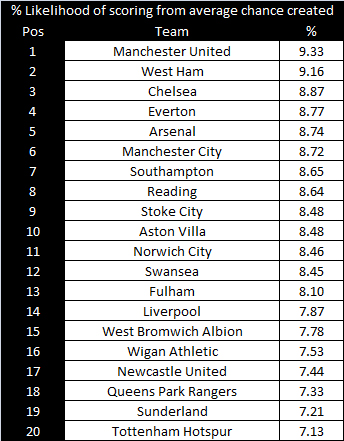 It must be re-iterated that these figures are based on the abilities of the average Premier League footballer. Imagine every players skill profile being dumped into a melting pot to produce one homogenised profile – RVP into the finishing mix with Scott Parker, Chico, Tony Hibbert, Gareth Bale et al.
Manchester United are creating the chances the average EPL footballer would find easiest to bag. They obviously have some tremendous attacking talent to finish the chances too. West Ham aren’t far behind in creating the kind of chances the average EPL footballer might take. Unfortunately for West Ham its squad is packed full of average EPL footballers (it may even be packed full of below average EPL footballers but the way the team is set up maximises their potential).
The next graphic shows the defensive side of things for last season:
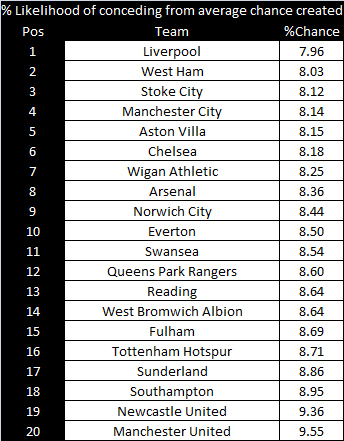 A couple of notable points here before we finish. Firstly, Liverpool being top of the tree. They are the best team at preventing the kind of shots you really want to. On the face of it, it would seem Brendan Rodgers system is working defensively. Liverpool didn’t concede much more than a goal a game.
However, look at that Manchester United figure. Not only do they create the best chances, they concede the best chances too. Yet United conceded the same amount of goals as Liverpool despite conceding 50 more shots. Maybe this is why Liverpool felt the need to replace Pepe Reina with Simon Mignolet and bring Kolo Toure in on a free. We’re comparing the two sides here not out of fairness but to illustrate a point.
The final point is around United’s extremism. It looks like further numerical evidence that United are content to sit back and soak up danger before hitting teams at the other end. Most of the top sides seek to control the game in the opposition half. United don’t. And it seems suckering opponents in may be a contributing factor in them creating great chances for themselves by transitioning quickly to exploit the gaps. Not only is their attack extremely efficient, their defence is able to prevent goals from the types of shot that other defences can’t.
Follow us on Twitter here.


 Differentgame Analytics
Leave a comment