On our travels through the Twittersphere we stumbled across a site called GoalImpact.com. It was written in German and had intriguing numbers attached to football players, so immediately we were curious. A quick Google translation later and we were hooked. The site is run by a chap called Jörg Siedel. We’ll leave it to him to explain:
“Everybody has their favourite players – the players they think add most to their team’s success. But this is entirely subjective. Increasingly, statistics are being used to objectify these assessments. Most of these statistics are bottom-up. People count the amount of completed passes, successful tackles, shots on target and many more things. But, while those statistics help to understand the game, I’d argue it that it’s difficult use them to measure the end product of a player on the field. The game of football is too complex to create a complete bottom-up model for it. We cannot easily interpret these kind of statistics to rank player performance without adding at least some subjectivity.
To avoid this, I try to measure a players performance top-down. I simply measure the player’s team’s goal difference when the player is on the field. I don’t look at how he effects his team’s goal difference.
In this raw definition, it would be a very imprecise measure as the team’s performance certainly rests on more factors than just the relative strength of an individual player. His performance also depends on:
- the players alongside him
- the strength of the opponent
- whether he has home advantage
- red cards shown to either side
- luck
The first four I can correct explicitly, but luck can only be accounted for by the regression toward the mean and by averaging over many games. By doing these calculations, I obtain an individual score for each player that I call GoalImpact. By definition, GoalImpact is a universal number whereby a defender can be as valuable as an attacker. To make the figure easily understandable, I transformed it to a scale in which the average player has a GoalImpact of 100.”
Differentgame asked Jörg to pick the optimal England squad of players still playing, based on GoalImpact. Here’s what it looks like:
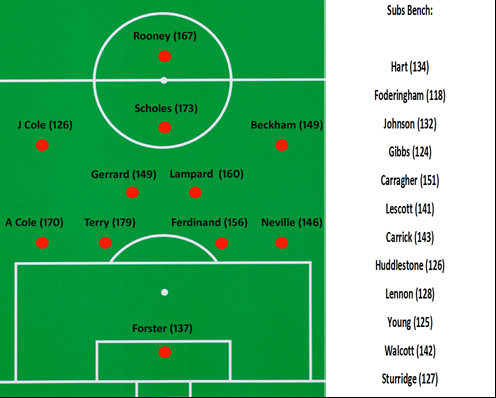
Now to us, that looks a snapshot of the national side over the last decade.
If you take out the “unrealistic” names – those now considered too old or no longer worthy (Scholes, J Cole, Beckham, Ferdinand, Neville, Carragher) the names Jörg replaces them with also look familiar. The next top rated players are the likes of Smalling, Wilshere and Oxlade-Chamberlain.
On this evidence it looks very much like the England squad has and continues to be picked purely on player outcomes than process. That the “best” players have been thrown into the mix with the hope that it gels. It’s worked to an extent, as numerous journeys past the group stages will testify. But the English FA routinely spend big money on luring manager after manager to do the same thing. Jörg, could have run it through his computer in minutes, and he’d probably have done it for free if you asked him nicely. On top of which, he speaks better English than Hodgson, never mind Capello.
If the average GoalImpact player is rated at 100, who’s the best? Cristiano Ronaldo at around 190. Next best is Leo Messi at around 188. So the world’s two greatest players actually do make a huge difference to their team.
We can’t resist asking Jörg what Gareth Bale’s GoalImpact score is. It’s 118. “Bale is not the best player at Spurs at all”, says Jörg. “Despite his talents, his team fails to perform significantly better when he is on the field.”
It looks like Bale will have to consistently perform for more than a dozen games before he’s mentioned in the same breath as those two.
If you like Jörg’s analysis, you should check out GoalImpact.com and follow him on Twitter and Facebook.


 Differentgame Analytics
Leave a comment